

Planetary Lineage
Just Where Do Those Deities Come From?

My esteemed colleague Meg Freitag gave an excellent 101 class on Mercury on the 11th of October 2025, for the Nightlight Astrology Speaker Series. If you are reading this article within 7 days of the published date, you can catch the recording here for free.
An excellent question came through the Q&A box from Adam at Sol Astrology, asking about the connections of Mercury to the Earth sign Virgo, not just as the domicile, but also as the exaltation lord of the sign. No other planet holds the distinction of being both exalted and in domicile, so Mercury is both in Virgo and, conversely, in detriment and fall in Pisces, it seems at first just a little quirk, the trickster quality we know and love.
Meg had already mentioned that the conjunction is not seen in traditional astrology as an aspect and speculated on the conjunction belonging to Mercury. Saturn is associated with the opposition, Jupiter with the trine, Mars with the square, and Venus with the sextile. On this, I agree; it is something I have considered for many years, especially as Mercury has its joy in the 1st house, a place that can be above or below the Ascendant degree and is rarely far from the Sun. Also, from an alchemical view, as the end product of the conjunction, Rebis, the divine two-headed hermaphrodite. I will not go into this as it is not my field, but if you are interested, I will leave you to study further.
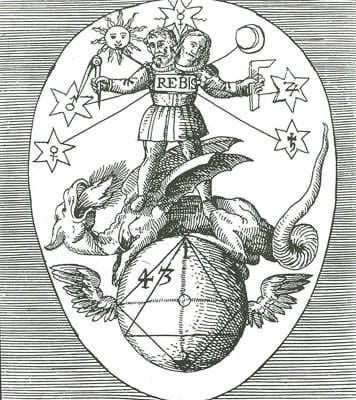
Heinrich Nollius (Life time: before 1700), Public domain, via Wikimedia Commons
Now, to the questions at hand, where do we get all these associations? Well, the ancients were phenomenal astronomers, mathematicians and philosophers. There were great men (yes, generally only men as far as surviving texts go) writing, discussing, cataloguing and creating detailed documents of their findings.
However, as those of you who have read the excellent book by Demetra George, Mysteries of the Dark Moon: The Healing Power of the Dark Goddess, will know, before the Egyptian, Greek, and Roman stories we know and love today, there were matriarchal communities that had their own beliefs and traditions.
We are told these traditions involved human sacrifice, cannibalism and torturous death. I am not sure the history is entirely accurate; it is, after all, the victors who live to tell the tale. However, I do not deny that it does seem that in some communities, this was part of their religious practices; I am just not sure how widespread these were.
Hermes is the name that the Greeks used for the winged messenger, whom we now call Mercury, as a placeholder for the closest planet to the Sun. As we can see from this step, a conquering nation takes over the land and the people, integrating the stories of the locals into their own system.
There are similarities but also differences between the Greek and Roman versions of the Deities. For example, Ares, the fierce warrior Gods name translates (depending on your sources) to bane, destroyer, ruin. A few words that express the challenging nature of this God.
Mars, though also a God of war, by the time he becomes fully integrated into a Roman, manages to learn some decorum and honour. He is the father of Romulus and Remus, therefore the Grandfather of the Roman nation. His name stems from Mãrvors and Mãrvortius, meaning moenia* to strengthen or defend a wall/hill. He has learnt the art of war, rather than just fighting for fighting’s sake.
There are many more connections for Mars that I have been researching for my talk at the Academy of Astrology conference on December 6th. I will be getting into all things Mars that day, as transiting Mars conjuncts my Ascendant, and at the time of the talk, it is also on the MC here in my hometown. I clearly couldn’t choose any other topic as this is also a trine to my natal Mars in Aries.
However, I digress! With regards to the discussion on Virgo as the exaltation and domicile of Mercury. I have been working my way slowly through the classic book by Robert Graves, The Greek Myths, over the last few months. It has been a fascinating insight into the way stories are intertwined, shift and change through interpretation, interaction and understanding.
Meg mentioned in her talk that the name Hermes came from herm, a stone pillar also called a cairn, which marks a boundary or place. Graves, in his description, states that;
**” Zeus’s rapes apparently refer to Hellenic conquests of the goddess’s ancient shrines, such as that on Mount Cyllene; his marriages, to an ancient custom of giving the title ‘Zeus’ to the sacred king of the oak cult. Hermes, his son by the rape of Maya - a title of the Earth-Goddess as Crone - was originally not a God, but a totemistic virtue of a phallic pillar, or cairn. Such pillars were the centre of an orgiastic dance in the Goddess’s honour.”
Once, Adam of SolAstrology asked the question regarding the domicile and exaltation of Mercury in the Earth sign of the descending Goddess on the verge of entering the underworld; this passage came instantly to mind.
If we consider the above statement and examine the symbolism of Virgo as the sign of the virgin —not as the modern understanding of a young girl, or a woman who abstains from sexual relations, but as the Goddess, who has chosen her partners and not had any forced upon her. As she prepares to descend into the underworld at the Autumn Equinox, we gain a deeper understanding of Hermes’s role. He stands guard over the place of her descent, marking the spot with a cairn and guides her with his lamplight into the underworld as the psychopomp.
The Earth Goddess, (Virgo,) holds the seeds of the following year's harvest within as the wheatsheaf, storing and protecting them through the winter in the belly of the Earth while in Her Crone phase until the following spring, when the warmth of Her beloved Sun God the seed of Her loins and also Her husband and King is strong enough to welcome Her back out into the overworld as the Divine Maiden again, beginning the eternal cycle.
The tarot cards that are associated with Mercury are the Magician; Here Mercury is the wily, clever, trickster who can manipulate all the elements. The Lovers is Gemini. In the Thoth (Egyptian name for Hermes) deck by Harris and Crowley, there is a brilliant depiction of the sacred children as an echo of the adult couple, illustrating the union of the divine male and female.
The Hermit is the card for Virgo. People often find this a strange connection when first coming to the Tarot. Still, now, with an understanding that the word “Hermit” itself stems from the Greek word ***eremites a person who wonders the desert alone, and that the only way to guide travelers in a desert lanscape was by building cairns, to mark the way, we can see how apt the old figure of cthonic Hermes wih his torch containing, the protected spark of spirit, to light the way is.
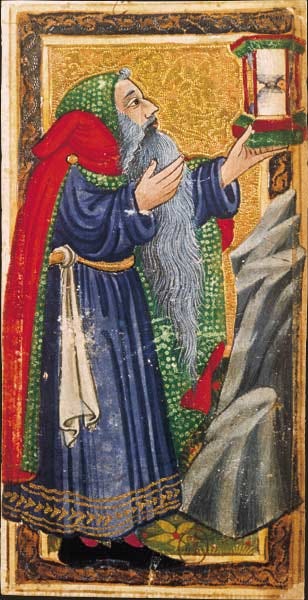
The above picture is the Hermit card from the Gringonneur Tarot (Charles VI) deck. The character here has an hourglass rather than a torch in his hand. The torch is at the top of the mountain/carin, as the guiding light. That flame looks to me like a demure lady looking back over her shoulder as she enters a cave. Or am I just imagining it?!
*https://archive.org/details/anelementarylat01lewigoog/page/496/mode/2up?q=Mars
** Graves, Robert, The Greek Myths - ISBN 9780140171990, Penguin, London England.
Dear Sofia,
Thank you :-)
The talk is for the AOAUK Conference; there are other wonderful astrologers there for the whole weekend.
Here is the link to the booking page.
https://www.eventbrite.com/e/academy-of-astrology-online-conference-tickets-1738493393539?aff=oddtdtcreator
And here is the AOAUK website.
https://www.academyofastrology.co.uk/
Wonderful write-up! The Welsh called Hermes or Herm — Myrddin, the god of journeys, and Merlin’s Welsh name, according to legend, was Imrys Myrddin. That kind of combines the Magician and the Hermit—doesn’t it, in the Merlin image?